
Does Currency Intervention Matter?
Governments still reach for the FX lever. Why intervention rarely holds a misaligned currency, and what that means for global investors.

Concurrently, developing economies have mostly switched from fixed to managed float since the currency crashes of the 1990s. This still leaves scope for official intervention if deemed necessary. To be sure, when currencies come under pressure, highly indebted EM countries are vulnerable to balance sheet effects (as external debt service increases in home currency terms) and elevated inflation risks (due to more costly imports). However, absent policies to resolve underlying structural imbalances, interventions have rarely been effective in sustaining fundamentally misaligned exchange rates, as the currency freefall in Türkiye since late 2021 illustrates.
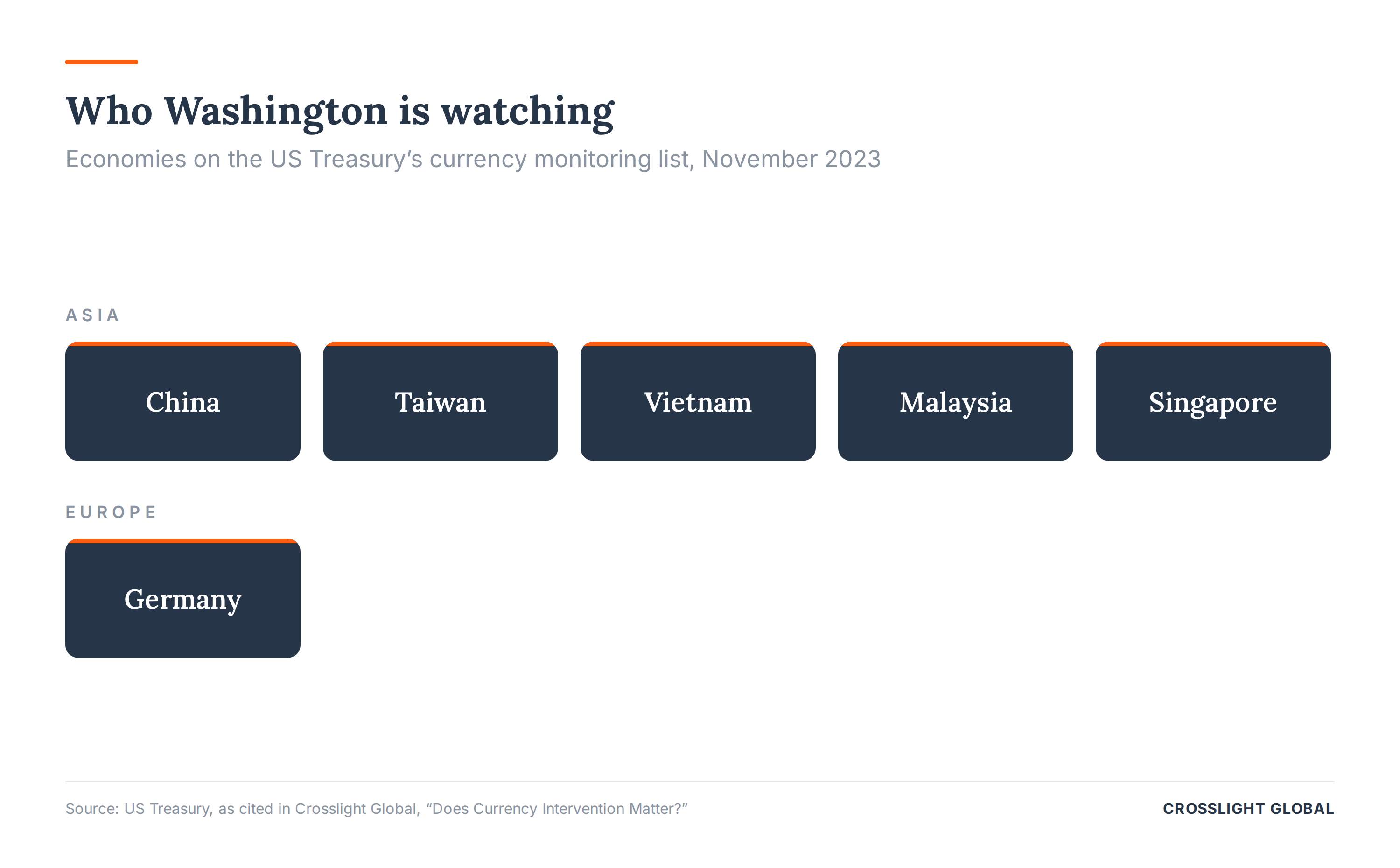
On the other hand, export-oriented countries are sometimes accused of seeking unfair trade advantage by suppressing the appreciation of their currencies, through buying large quantities of USD. Herein lies the notion of currency manipulation that is central to the US Treasury’s semiannual report mandated by the US Congress in its Omnibus Trade and Competitiveness Act of 1988. In the last report of November 2023, five of its trading partners in Asia (China, Malaysia, Singapore, Taiwan, and Vietnam), alongside Germany, are on its monitoring list. The next report is due later this month.
Going back to the question at hand, currency intervention is legitimately an operative response to smooth out inordinate market volatility. However, there is weak evidence regarding the efficacy of central bank intervention to dictate or defend a specific level of exchange rate, especially if it is out of line with economic fundamentals. Indeed, frequent interventions could have the opposite effect of undermining policy credibility and risk stoking speculative elements. For a country with a flexible regime, the exchange rate is, at the core, a manifestation of its monetary fiscal policy mix.
CrossLight views exchange rates as presenting both opportunity and risk for the dollar-based global investor. Value hunters in search of under-valued currencies stand to benefit from potential appreciation and/or positive carry from long positions. Conversely, for allocations in countries where exchange rates are trading rich or appear out of line with long-term fair values, currency hedges are imperative in preserving returns in USD terms. In the extreme, a failure to restore currency stability could lead to policymakers swapping capital mobility for quantitative controls. With global rates in a higher-for-longer mode and given geopolitical changes, the currency factor must accordingly be subject to dynamic surveillance and not left to benign neglect.
---
*Tags: Emerging Markets, Currency, Global Economy, Exchange Rate, Monetary Policy*