
The Player Haters Ball: How Political Bias Quietly Undermines Empirical Analysis
How heated politics on both sides are distorting investment judgment and creating blind spots that cost families real money.

How heated politics on both sides are distorting investment judgment and creating blind spots that cost families real money.
In the early 2000s, before smartphones and algorithmic feeds, The Chappelle Show aired a skit called “The Player Haters Ball.” It was designed to be absurd and nothing more. Today, it reads less like a joke and more like the world we now recognize.
At some point, political identity stopped being just an opinion. It became a filter through which almost everything is interpreted, from what people buy and listen to, to what they share, to whom they trust, and increasingly, how they invest. What was once a joke has become a pattern. People let frustration or tribal loyalty drive them into choices that have nothing to do with reason or discipline.
Bias creates blinders, and blinders create missed opportunities.
## When Politics Leaks into the Portfolio
We have reached a point where many investors are no longer focused on fundamentals, valuations, macroeconomic conditions, or free cash flow. Instead, they end up responding to politics more than anything that truly drives markets.
Depending on where your loyalties sit, the same data can look like boom or bust. That’s the problem. People project their politics onto markets and call it analysis.
Neither of these is investment analysis. Both are emotional projections onto markets that neither reward nor punish panic or euphoria.
A 2025 study by Cassidy, Vorsatz and Rice linked mutual fund managers’ party registration to their trading behavior. After Trump’s unexpected 2016 win, Republican-majority teams increased high-beta stock purchases, added roughly two percentage points of equity exposure, and saw short bursts of abnormal returns in politically favored high-beta names.
Their Sharpe ratios fell, meaning they were taking more risk for less reward, with no improvement in long-term outcomes. Politics did not make them better investors. It made them less disciplined investors. And that was nearly a decade ago. The partisan imprint on investing is even more profound today.
## The Election Is Doing More Damage Than the Market
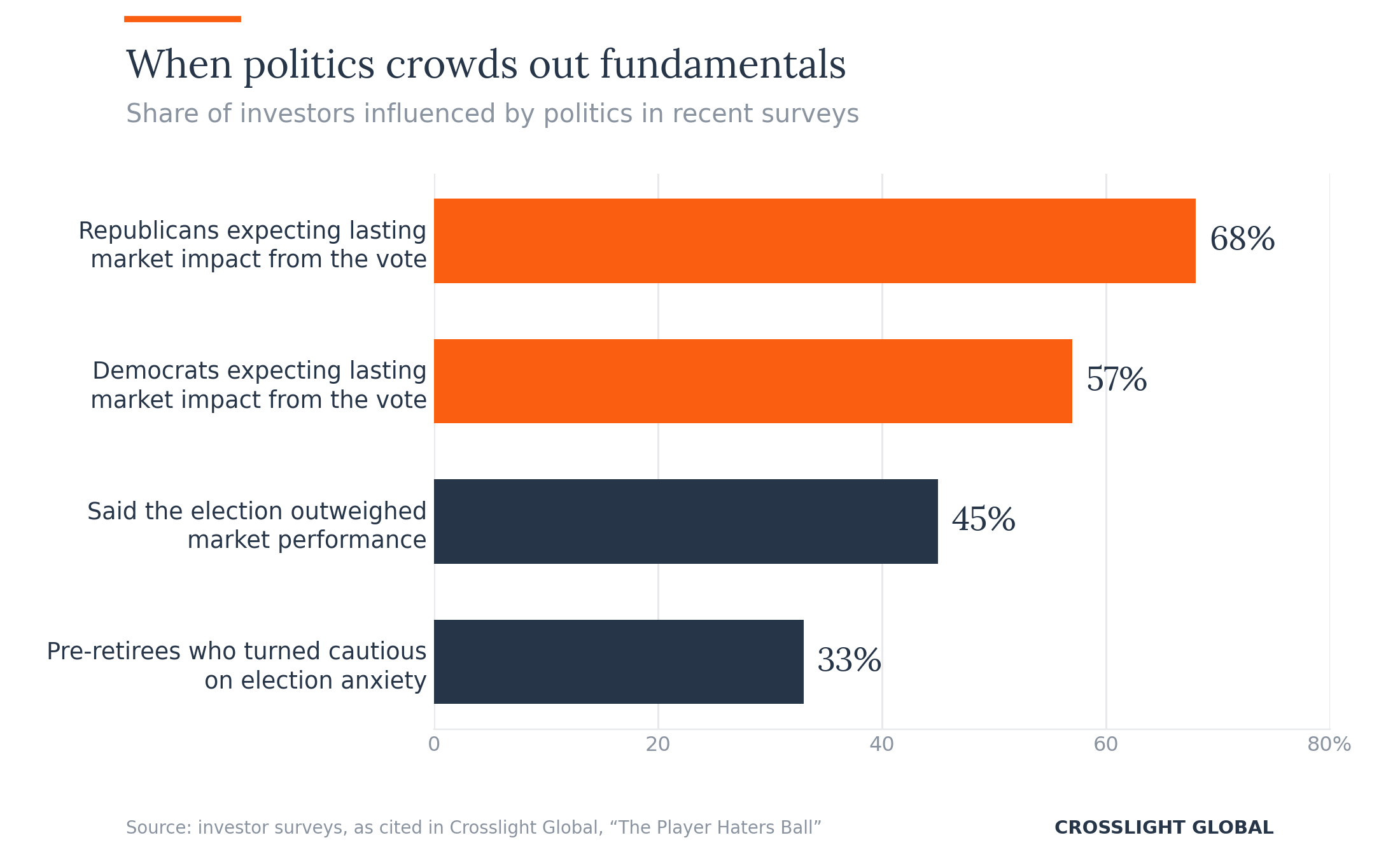
Surveys show the pattern clearly:
- 45% of U.S. investors say the 2024 election influenced their retirement decisions more than market performance.
- 33% of pre-retirees became more conservative specifically because of election anxiety.
- 68% of Republicans and 57% of Democrats believe presidential outcomes have immediate and lasting effects on markets.
Pause on that for a moment.
When nearly half the country believes an election, not interest rates, earnings, or growth, is the primary risk to their portfolio, something fundamental has shifted. We are no longer allocating capital with discipline. We are allocating with emotion.
Markets do not reward emotional investing. They punish it.
We should allocate based on expected cash flows, global supply and demand, valuations, interest-rate regimes, and structural risk. Instead, too many investors allocate based on identity, fear, or the desire to see their side vindicated. That is not investing. That is venting. And markets have no patience for it.
My time in fixed-income emerging markets taught me to respect political risk. You don’t ignore it. You closely watch policy, regulation, and geopolitics. But I also learned not to let it drive the whole decision. It’s a piece of the puzzle. It’s not the entire picture.
## From Stock Selection to Seeking Validation
There was a time when people stress-tested cash flows, built dividend discount models, and really dug into the credit. You understood the duration risk on a specific issue because you had to. Today, too many investors take their cues from pop-up gurus on Seeking Alpha, social media personalities with bought blue checks, chaotic Discord chats where everyone talks over each other, or Reddit threads that read more like support groups than research.
This is not an analysis. It is people looking for someone who hates the same things they do and mistaking that for insight.
But here is the truth: politics is emotional, and portfolio management cannot be.
## People at My School Don’t Like Taylor Swift Anymore
This dynamic is not limited to adults. Recently, my ten-year-old daughter, Elise, was humming a tune in the car. I asked her if it was Taylor Swift. She rolled her eyes, as only a ten-year-old can, and said, “No, Dad, people at my school don’t like Taylor Swift anymore.”
Why? They just don’t.
In September 2024, Swift endorsed Kamala Harris. Afterward, Economist and YouGov tracking showed GOP favorable views falling from about 50% to 26%, and unfavorable opinions rising to 67%, with only a partial recovery through 2025. I don’t think Swift changed her music. People changed their feelings. And even kids could feel the shift.
## The Player Haters Portfolio Is a Losing Strategy
People vote with their feelings. They consume with their feelings. And increasingly, they invest with their feelings.
The problem is not with having political opinions. The problem is allowing those opinions to override financial discipline, prudence, and stewardship.
Markets do not care about your ideology, your media diet, or your emotional responses. Markets care about rates, liquidity, earnings, risk, and time.
You don’t need to approve of everything happening in the world to succeed in it. You just need to think clearly.
## In Closing
The Player Haters Ball is funny because it’s exaggerated. Your portfolio doesn’t get that luxury. Your retirement, your kids’ future, your long-term plans, all of it depends on clear thinking, not political heat.
Step away from the noise. Make room for actual opportunity.
---
Tags: Investing, Personal Finance, Politics, Behavioral Finance, Culture